The court system in ancient Greece was taken seriously. Anyone could bring a charge against another person in ancient Greece. There was no prosecutor. But there were rules you had to follow to have your case heard in court.
FIRST: You had tell the person that you were going to start an action against them to be heard in "court". You had to bring witnesses with you so your witnesses could testify that the person was told why you were bringing an action, and that you had given this person a date, time, and location that they had to appear in court to defend themselves.
SECOND: You had to post a written notice near the courthouse that clearly stated the names of both parties, the charges, and the date, time, and location of your first trip to court on this action.
FIRST TIME IN COURT: The first trip gave both parties a chance to speak before a judge. If the judge felt there was enough cause, that judge would assign a trial date. That trial date had to be posted as well.
JURY SELECTION, TRIAL BY JURY: To be on a jury, you had to be a citizen. You had to be over 30 years of age. You had to swear that you would be fair to both sides. You did get paid. Juries were selected from volunteers. The number of jurors could be huge. Some trials had as many as 500 jurors who had volunteered to judge a case. Only the jury could bring in a decision that someone was guilty or innocent. The judge only kept order, but could not decide a trial outcome.
THE TRIAL: Both sides presented their case. Then the jurors voted. Majority ruled.
PUNISHMENT: Punishments varied. If found guilty, both sides, the person bringing the charge and the person being charged, suggested a punishment. The jury could not choose a third choice. They had to choice one suggestion or the other.
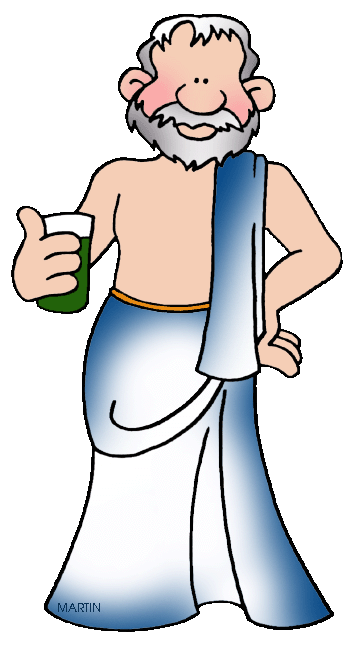
FAMOUS ANCIENT GREEK TRIAL: The trial of Socrates. Nothing probably would have happened to Socrates if he had followed the rules. He knew how the court system worked in ancient Athens. But when the court him guilty, he was angry. The other side suggested death as punishment. Socrates, who found the charges against him ridiculous, suggested his fine be one piece of silver. He knew the jury would be angered by that. If Socrates had suggested a stronger punishment, the jury probably would have voted for it. But he left them little choice. By law, they had to pick one side's suggestion or the other, and be fair about it. Socrates had to treat the trial seriously. He did not, and it cost him his life.
Trial by jury was not invented by the ancient Greeks. But it was fine tuned. We use many of their steps in our court system today.
In the USA today, a defendant can choose to have a judge rather than a jury trial. But the right to trial by jury is the right of every American citizen. When a jury trial is selected, here's how it works:
- Jury Selection. It is very citizens obligation to serve on a jury if called to do so. For jury trials, there are 6-12 jurors. Jurors are paid, very little, but they are paid around $10 a day plus mileage. To be on a jury, you have to be a citizen of the US, 18 or older, and you cannot be a convicted felon whose right to be a juror has been taken away.
- After a jury has been selected, the jury hears opening statement by the attorneys. Then evidence is presented. There are closing arguments by the attorneys. Jury instruction is given by the judge. And the jurors are moved to a private room to discuss their decision among themselves. Once a jury reaches a decision, they go back into court and give their decision to the judge. In some types of trials, punishment is decided by the judge. In others, a jury decides it, but a judge can overrule their punishment if he or she thinks it is unreasonable or illegal.

Explore Ancient Greece
For Kids: Overview
Early Greece: Minoans, Mycenaeans, Dorians
Rise of Greek City-States
- On Land: Greek Warriors
- At Sea: Greek Ships
- Trojan War
- Persian Wars
- The Delian League
- Peloponnesian War
- Alexander the Great
- The League of Corinth
Investigate Real Life Artifacts
For Kids: Art, Culture, Government
For Kids: Greek Mythology
Ancient Greek Myths for Kids, retold by Lin Donn
- Zeus, Hera, and Little Io
- The Competition, Athena and Poseidon
- Theseus, the Minotaur, and the Maze
- Dionysus and Ariadne
- Icarus and Daedalus, Wings
- The 12 Labors of Hercules
- Demeter and Persephone, Reason for the Seasons
- Apollo's Oracle at Delphi
- Perseus, Andromeda, and the sea god, Poseidon
- King Midas and the Donkey Ears
- And Many More
Ancient Greek Gods & Goddesses
For Kids: Ancient Greek Daily Life
For Kids: People
For Kids: Interactive Quizzes
Alexander the Great &
Gifts from the Greeks
For Teachers
For Kids and Teachers: Other Ancient Civilizations
See Also: Early Humans for Kids and Teachers